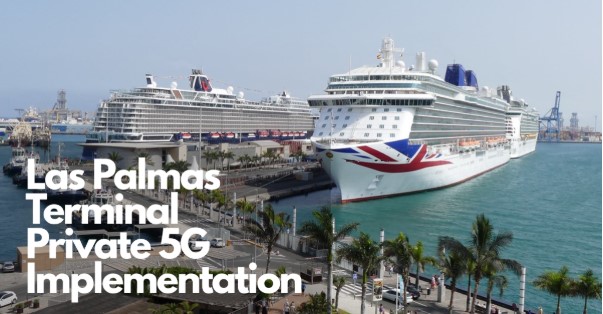
A private 5G network is being deployed at the Canary Islands’ largest container terminal in Las Palmas to add real-time connectivity across the yard, cranes, and operational staff. The terminal operator has contracted a neutral host integrator to design, deploy, and run the network using Nokia’s Digital Automation Cloud platform.
This project represents a shift from traditional wired or LTE-based systems toward more flexible, wireless operations in port settings. Below is a technical view of how it is structured, how it supports operations, and what performance improvements are expected. So, now let us look into Private 5G Deployment at Las Palmas Terminal along with Accurate LTE RF drive test tools in telecom & Cellular RF drive test equipment and Accurate Wireless Survey Software Tools & Wifi site survey software tools in detail.
System Design and Architecture
Network topology
- The private 5G setup uses a dedicated core (private core) and radio access network (RAN) nodes placed across the terminal area.
- The connectivity is delivered as a managed service by the integrator (neutral host model), so the terminal doesn’t have to manage the infrastructure directly.
- The radio access includes distributed small cells or RRUs (remote radio units) to cover cranes, container stacks, and yard equipment.
- Field routers or industrial gateways are used to connect remote equipment (like RTG cranes) into the 5G network.
Key components
- Core network (5G core) handles mobility, session management, network slicing (if needed), and traffic routing.
- Edge compute nodes may be placed close to RAN to run latency-sensitive applications (e.g., crane telemetry analytics).
- Backhaul links connect RAN to core. In many cases, these may replace fiber links or reduce fiber usage, especially for tall or moving infrastructure (cranes).
- Devices (operator tablets, crane controllers) connect to RAN with either standard 5G UE modules or mobile terminals supporting 5G.
- A license pool manager and device swap logic allow dynamic allocation of licenses across UEs.
- Data retention mechanisms ensure historical logs remain accessible even if a device is removed (via archive bin or database).
Because the network is dedicated to the terminal, the operator can isolate traffic, enforce security policies, and guarantee quality for mission-critical applications.
Use Cases & Functional Flows
Several use cases drive the deployment. Below are the main ones with how traffic flows and how it supports operations.
Connected worker / operator tablets
- Workers carry tablets to scan container IDs, inspect machinery, or report status.
- These tablets send telemetry, images, or maintenance logs to backend systems in real time.
- The 5G connection ensures lower latency and consistent throughput compared to Wi-Fi or LTE in busy terminal zones.
RTG crane digitization
- RTG (rubber-tyred gantry) cranes have onboard PCs or controllers mounted tens of meters above ground.
- Instead of laying fiber or heavy civil works, the cranes connect wirelessly to the 5G network.
- Real-time commands, position data, sensor feedback, and camera feeds transit over 5G.
- This reduces infrastructure cost and complexity while enabling remote or assisted operation.
STS crane monitoring and telemetry
- Ship-to-shore (STS) cranes often span over the vessel and port edge—sometimes over 100 meters high.
- These cranes generate telemetry, vibration data, power usage, load feedback, and status logs.
- 5G allows these data streams to reach the core without installing fiber along boom arms, saving on civil costs.
Cold chain / refrigerated container monitoring
- Refrigerated (reefer) containers need continuous monitoring of temperature, power, and status.
- Deploying sensors within containers and connecting them to the 5G network ensures that maintenance alerts or anomalies are reported promptly.
- This helps reduce losses due to spoilage or malfunctions.
Backup / redundancy for wired systems
- In areas where fiber is fragile or difficult to maintain, 5G can act as a backup path.
- It can carry redundant data or take over in failover mode when wired links fail.
Operational Benefits & Cost Reductions
The Las Palmas deployment is expected to deliver multiple advantages over legacy methods:
- Reduced civil and fiber works
- Eliminates much of the need to run fiber to cranes or elevated structures.
- Reduces trenching, conduit, and maintenance costs associated with wired infrastructure.
- Greater flexibility and scalability
- When operations change (e.g. new crane, reconfigured yard layout), adding or relocating coverage is easier.
- Additional sensors or endpoints can be added without digging new fiber paths.
- Improved reliability and uptime
- Wireless links eliminate single points of failure in physical cabling.
- Redundant paths and automatic rerouting via core logic provide resilience.
- Operational visibility
- Real-time telemetry and analytics allow early detection of failures, predictive maintenance, and optimization of resource usage.
- Data from cranes, inventory, and workers feed into the terminal’s operations systems for better decision making.
- Predictable cost model
- Using a managed service approach turns capital expenses (CAPEX) into operational expenses (OPEX).
- Terminal can forecast costs yearly rather than budgeting for unpredictable infrastructure projects.
- Lower latency and deterministic behavior
- With private 5G, latency can be controlled, enabling near-real-time control loops (important for automation).
- Network slicing or priority queues can guarantee performance for critical applications.
Challenges, Constraints & Considerations
No deployment is without constraints. Some technical aspects to watch:
- Coverage planning
The terminal has multiple metal obstacles (containers, cranes, shipping containers) which cause signal reflections and shadow zones. Careful placement of small cells is needed. - Interference and isolation
Operating in a busy RF environment (adjacent macro networks, Wi-Fi, radio) demands strong interference management and spectrum isolation strategies. - Latency and jitter
For control loops (e.g., crane motion control), jitter must be low. Edge compute and prioritization are key. - Device compatibility
End devices must support the 5G bands used. Legacy gear or off-the-shelf modules may require upgrades. - Backhaul capacity
The wireless or fiber backhaul must handle bursts of data, especially video feeds or high-throughput telemetry. - Security and segmentation
Because the terminal operate sensitive logistics infrastructure, strict network segmentation, authentication, and encryption must be enforced. - Scalability and future upgrades
The architecture must allow for future growth—additional endpoints, possible 6G migration, more analytics on edge.
Deployment Timeline & Rollout Phases
The rollout typically follows staged phases:
- Pilot / Proof of Concept
- Deploy RAN in a limited zone (e.g. a few cranes, yard pockets).
- Validate links, latency, throughput, and interference.
- Use-case validation
- Run end-to-end flows: connected workers, crane telemetry, remote sensing.
- Compare performance vs wired or legacy systems.
- Full coverage rollout
- Expand RAN to full yard, crane zones, reefer areas, etc.
- Install edge compute nodes and integrate with core.
- Optimization & tuning
- Perform RF tuning, path balancing, load testing.
- Add fallback, redundancy, and high-availability features.
- Scaling & enhancements
- Add more devices, data streams, advanced analytics modules.
- Potentially integrate with warehouse systems, terminal operations systems (TOS), or even future 6G.
Broader Implications & Future Prospects
The Las Palmas deployment demonstrates how ports can evolve from wired, manual systems to highly connected, automated operations. As more terminals adopt private 5G, we may see:
- Standardization of private wireless in ports and logistics hubs
- Migration paths toward 6G features (higher frequencies, more intelligence)
- Integration of robotics, autonomous vehicles, and automated cranes relying on reliable low-latency links
- More advanced analytics and AI on edge nodes for predictive operations
In summary, the Canary Islands terminal private 5G deployment is a technical step forward in operational digitization. It applies well-understood 5G architecture, with careful design, to deliver real benefit in a challenging industrial setting.
About RantCell
RantCell is a mobile network testing and monitoring platform that enables users to measure 2G, 3G, 4G, and 5G network performance directly through smartphones. It supports automated testing, live dashboards, and remote analysis—without the need for complex hardware setups. Also read similar articles from here.