Enterprise security is becoming increasingly complex. Employees may need secure access to computers, cloud applications, corporate networks, VPNs, offices, and restricted facilities, often using separate credentials for different environments. This fragmented approach can increase administrative overhead while creating a less consistent user experience.
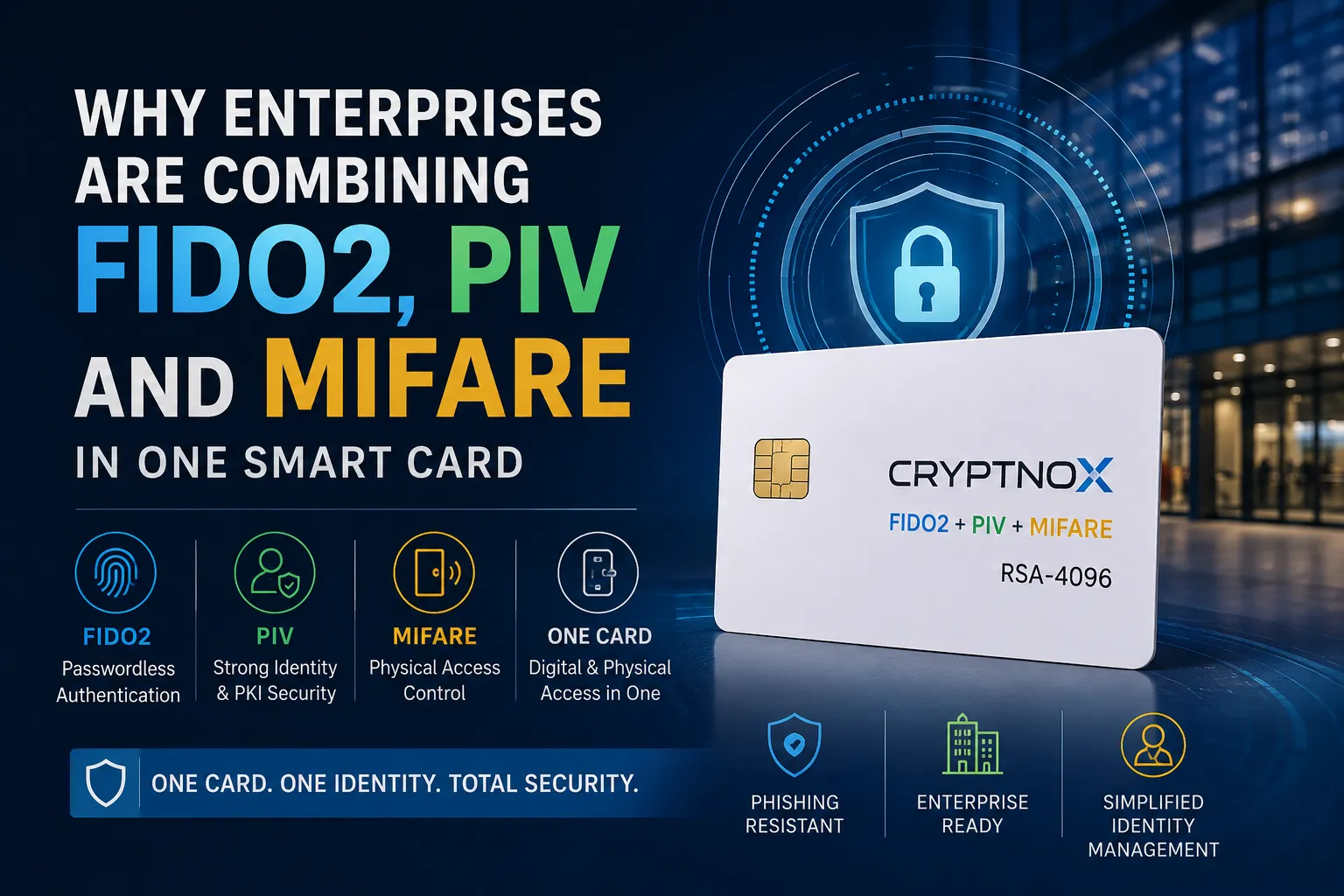
A FIDO2 PIV card offers an approach to consolidating enterprise identity and authentication capabilities into a single credential. By combining FIDO2 authentication, PIV-based identity credentials, and MIFARE technology, organizations can address different authentication and physical-access requirements through one smart-card form factor.
This convergence is particularly relevant for organizations looking to strengthen identity security, simplify credential management, and reduce the number of cards employees need to carry.
What Is a FIDO2 PIV Card?
A FIDO2 PIV card combines two important approaches to enterprise authentication within a smart-card environment.
FIDO2 is designed to support strong, phishing-resistant authentication and passwordless sign-in for compatible applications and services. PIV, or Personal Identity Verification, is associated with certificate-based identity and authentication, particularly in enterprise and government environments.
MIFARE adds another capability: contactless functionality commonly used for physical-access applications.
When these technologies are integrated into a single credential, an employee may be able to use one card for multiple identity and access scenarios rather than relying on separate credentials.
The exact capabilities depend on the card architecture, supported standards, enterprise infrastructure, and deployed access-control systems.
Why Are Enterprises Moving Toward Converged Credentials?
Traditional enterprise environments often use separate credentials for logical and physical access. An employee might carry one badge to enter an office, another credential for computer authentication, and additional authentication methods for cloud services or VPN access.
A converged employee credential can reduce this fragmentation.
Instead of managing disconnected identity mechanisms, organizations can build a more unified authentication strategy around a single physical credential.
The potential benefits include:
- Simplified credential management
- Fewer physical cards for employees
- Stronger authentication options
- Better alignment between digital and physical security
- A more consistent employee experience
- Centralized identity and access policies
A converged employee credential does not eliminate the need for careful identity governance. Organizations still need appropriate enrollment, provisioning, revocation, recovery, and lifecycle-management processes.
How FIDO2 Strengthens Enterprise Authentication
FIDO2 provides a modern approach to authentication that can reduce dependence on passwords. Instead of relying solely on something a user knows, FIDO2 authentication can use a cryptographic credential associated with an authenticator.
This is valuable because passwords remain vulnerable to phishing, credential theft, reuse, and database breaches.
An enterprise FIDO2 smart card can provide a physical authentication factor while supporting compatible passwordless or multifactor authentication workflows.
For example, an organization might deploy FIDO2 authentication for cloud applications while requiring employees to present their physical credential during authentication. This can provide a stronger alternative to password-only access.
The Role of PIV in Enterprise Identity
PIV provides a different but complementary capability.
A PIV smart card can store and use digital certificates for identity verification, authentication, signing, and other certificate-based applications. This makes PIV particularly relevant to organizations that already operate a public key infrastructure (PKI).
PIV can support use cases such as:
- Certificate-based Windows authentication
- Enterprise application authentication
- Digital signatures
- Secure email workflows
- VPN authentication
- PKI-based identity management
An enterprise PIV card can therefore serve as a hardware-backed identity credential within an organization’s existing certificate infrastructure.
The combination of PIV and FIDO2 allows enterprises to support both established certificate-based workflows and newer passwordless authentication methods.
Where MIFARE Fits Into the Smart Card
MIFARE technology brings the physical-access side of identity management into the equation.
Many organizations need employees to authenticate digitally and physically. Accessing a workstation or cloud application is one requirement; entering an office, restricted room, or controlled facility is another.
A PIV MIFARE smart card can help bridge these requirements when the organization’s physical-access infrastructure supports the relevant MIFARE technology.
This creates the possibility of using one physical credential across multiple environments.
One Card for Digital and Physical Access
Consider an employee arriving at a corporate office.
The same credential could potentially support:
- Physical entry through a compatible access-control system.
- Certificate-based identity authentication where PIV is deployed.
- Passwordless authentication through FIDO2 for supported services.
- Additional enterprise authentication workflows based on the organization’s infrastructure.
The objective is not simply to put several technologies onto one card. The real value comes from integrating identity policies and access workflows around a unified credential.
Security and Management Benefits
Combining authentication and physical-access capabilities can also simplify credential administration.
Instead of issuing and managing multiple employee credentials, organizations can potentially maintain a single enterprise identity badge with multiple security functions.
This can improve several areas of identity management:
Credential lifecycle: A unified credential can simplify employee onboarding, role changes, and offboarding.
Access revocation: When an employee leaves the organization, access associated with the credential can be revoked according to established policies.
User experience: Employees have fewer credentials to carry and remember.
Security architecture: Organizations can combine modern FIDO2 authentication with established PIV and physical-access infrastructure.
However, security depends on proper implementation. Strong hardware does not replace secure enrollment, certificate management, access-control policies, endpoint security, or employee security awareness.
Is a Combined FIDO2, PIV and MIFARE Card Right for Every Enterprise?
Not necessarily. Organizations should first evaluate their authentication architecture, PKI environment, physical-access systems, application compatibility, and identity-management requirements.
A combined credential is most useful when an organization has a genuine need for multiple authentication and access technologies.
Enterprises should assess:
- Existing PIV and PKI infrastructure
- FIDO2 compatibility across applications
- MIFARE-based physical-access requirements
- Certificate lifecycle management
- Employee onboarding and offboarding
- Credential recovery and replacement procedures
- Compliance and security requirements
The objective should be to create a coherent identity strategy rather than adopting additional technology simply because it is available.
The Future of Converged Enterprise Identity
As organizations adopt passwordless authentication while continuing to operate established PKI and physical-access systems, convergence is becoming increasingly practical.
A FIDO2 PIV card can provide a bridge between modern authentication and established enterprise identity infrastructure. Adding MIFARE capabilities can further extend that credential into physical-access environments.
For organizations evaluating this model, a FIDO2 PIV card can represent a unified approach to authentication and identity management. An enterprise FIDO2 smart card can support modern authentication requirements, while a PIV MIFARE smart card can address environments where digital identity and physical access need to work together.
Conclusion
The move toward converged credentials reflects a broader change in enterprise security. Organizations increasingly need strong digital authentication, certificate-based identity, and physical access control without creating unnecessary complexity for employees.
Combining FIDO2, PIV, and MIFARE within one smart-card architecture can address these requirements through a unified enterprise identity badge. FIDO2 can support modern passwordless authentication, PIV can provide certificate-based enterprise identity, and MIFARE can support compatible physical-access environments.
A FIDO2 PIV card is therefore more than a convenient employee credential. When properly implemented, it can become part of a broader identity strategy connecting digital authentication, enterprise PKI, and physical access through one managed credential.