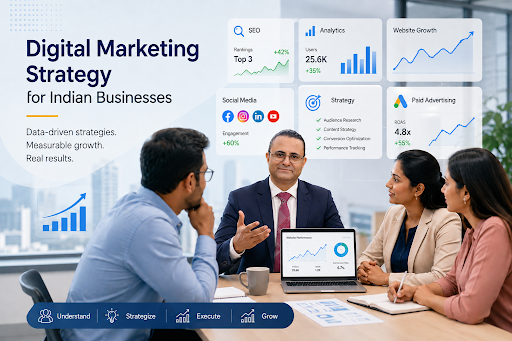
Digital marketing has become easier to start and considerably harder to manage well.
A business can launch a website in days, open social media accounts within hours, start running Google or Meta advertisements almost immediately and now produce large quantities of content with artificial intelligence. Yet having access to more marketing tools has not automatically produced better marketing decisions.
For many businesses, the real problem in 2026 is no longer a shortage of digital channels. It is the absence of a clear strategy connecting those channels.
SEO may be handled by one person, social media by another, paid advertising by an agency, website development by a technology vendor and content through an internal team or AI tools. Each activity can appear productive on its own while the overall business continues to struggle with inconsistent leads, rising acquisition costs or weak conversion rates.
This is where a consulting-led approach to digital marketing becomes increasingly valuable.
Instead of beginning with the question, “Which marketing service should we buy?”, a consulting-led model begins with a more important question:
“What is preventing this business from achieving its marketing objective, and which combination of actions should solve it?”
That difference can save considerable time, advertising expenditure and managerial effort.
Digital Marketing Is No Longer a Collection of Independent Services
For years, businesses commonly approached digital marketing as a checklist.
Build a website.
Do SEO.
Post regularly on social media.
Run Google Ads.
Try Facebook and Instagram advertising.
Create videos.
Generate backlinks.
Send emails.
Each activity has value. The difficulty arises when they operate independently without a common commercial objective.
Imagine a company investing heavily in Google Ads while its landing pages are slow and unclear. More advertising may simply send additional visitors into a weak conversion journey.
Another company may produce four SEO articles every month while its website architecture prevents important service pages from receiving sufficient internal authority.
A business may spend heavily on Instagram content while its actual customers make buying decisions through Google Search or LinkedIn.
None of these activities is necessarily wrong. The problem is their sequence, priority or alignment.
An effective digital strategy therefore needs to consider the complete customer journey rather than individual marketing tools.
Strategy Should Come Before Execution
Businesses understandably like visible activity.
Advertisements running, posts being published and new backlinks appearing in reports provide a sense of progress. Strategic work appears less visible because much of it happens before execution begins.
Yet some of the most valuable marketing decisions involve deciding what not to do.
A useful strategic review may reveal that:
- the business does not require more website traffic but better conversion;
- Google Ads should be prioritised before Meta Ads;
- a technical SEO problem should be corrected before producing more content;
- the company needs better positioning rather than a larger advertising budget;
- LinkedIn is more commercially relevant than Instagram for its B2B market;
- existing pages should be improved before dozens of new articles are commissioned;
- lead quality, rather than cost per lead, should become the primary metric.
These conclusions cannot be reached reliably by looking at one marketing channel in isolation.
This is one reason experienced businesses increasingly seek the perspective of a digital marketing consultant in India before committing substantial budgets to execution.
The purpose of consulting is not to replace specialists or agencies. It is to ensure that specialist execution is pointed in the right direction.
Start With the Business Objective, Not the Marketing Platform
Google, Meta, LinkedIn, YouTube and other platforms naturally encourage businesses to use more of their products.
The business owner, however, has a different responsibility.
The objective is not to achieve maximum advertising activity, impressions, clicks or followers. The objective may be to generate qualified enquiries, sell products profitably, build distributor relationships, improve market authority or create a dependable pipeline of customers.
Marketing objectives should therefore be translated into measurable business questions.
For example:
Instead of:
“How do we get more website traffic?”
Ask:
“Which prospective customers should visit the website, what are they trying to accomplish and what should happen after they arrive?”
Instead of asking:
“Should we run Meta Ads?”
Ask:
“Where does our audience discover, evaluate and purchase our category?”
Instead of:
“How many backlinks should we build every month?”
Ask:
“Which websites, publications, associations and conversations would genuinely strengthen our subject authority and discoverability?”
This change in questioning produces better marketing decisions.
SEO Has Become Broader Than Ranking for Keywords
Search engine optimisation remains an important component of digital growth, but modern SEO extends beyond inserting keywords into pages and collecting backlinks.
A business needs to consider several interconnected elements:
Search Intent
A keyword alone tells only part of the story.
Someone searching for “digital marketing strategies” may be learning. Someone searching for “digital marketing consultant” may be evaluating professional help. Someone searching for a particular consultant’s name may already be in the final stages of decision-making.
Content should reflect those differences.
Website Structure
Search engines need to understand which pages are important and how different topics are connected.
Strong website architecture, sensible internal links, clear service pages and technically accessible content can often be more valuable than continuously publishing disconnected articles.
Expertise and Trust
Businesses operating in competitive markets cannot rely entirely on generic content.
Experience, specialist commentary, genuine case studies, original observations, professional credentials and transparent business information help users understand why they should trust a particular source.
Authority Beyond the Website
A company’s own website cannot be the only place describing its expertise.
Independent mentions, interviews, business profiles, citations, relevant industry contributions and editorial coverage help create a broader digital footprint.
This is where carefully chosen guest contributions can have genuine value: not merely because they contain a hyperlink, but because they place expertise within another relevant editorial environment.
Paid Media and SEO Should Inform Each Other
SEO and advertising are often managed as competing disciplines.
In practice, they can produce better decisions when their data is shared.
Google Ads can quickly reveal which search terms generate genuine enquiries. That information can influence SEO priorities.
Organic search data can identify topics attracting consistent interest, which may then be tested through paid campaigns.
Landing-page behaviour can expose weaknesses affecting both organic and paid visitors.
Successful advertising copy can reveal messages that resonate strongly enough to influence website positioning.
The objective should not be to prove whether organic or paid marketing is “better.” Each serves a different function.
Paid media can create immediate reach and provide fast market feedback.
SEO can build discoverability and authority that accumulates over time.
A mature strategy understands where each belongs.
Social Media Should Support Positioning, Not Merely Posting Frequency
Many social media plans still begin with a calendar:
Monday — educational post
Wednesday — promotional post
Friday — motivational content
Regularity matters, but frequency without strategic relevance creates activity rather than authority.
For consultants, professional firms and B2B organisations, social content should demonstrate how they think.
For consumer brands, content may need to demonstrate usefulness, aspiration, community or product experience.
For manufacturers and exporters, LinkedIn may support credibility and business relationships more effectively than trying to build entertainment-style engagement elsewhere.
The relevant question is therefore not, “How often should we post?”
It is:
“What should a prospective customer understand about our business after following us for three months?”
That answer should guide content.
AI Makes Strategic Judgment More Important, Not Less
Artificial intelligence has dramatically reduced the cost and time required to create marketing material.
Businesses can now research topics, outline campaigns, analyse data, create graphics, draft advertisements and produce content much faster.
This efficiency is valuable.
It also creates a new problem: producing the wrong thing has become much easier.
A company without strategic direction can generate hundreds of pages, advertisements and social posts without strengthening its market position.
The competitive advantage is consequently shifting from content production toward judgment.
Businesses need people who can determine:
- which information matters;
- which audience deserves priority;
- what should be automated;
- where human expertise is essential;
- which AI output requires verification;
- which metrics actually indicate business progress.
AI can accelerate execution. It cannot automatically determine the commercial priorities of an organisation.
Measurement Must Move Beyond Vanity Metrics
Digital marketing dashboards can display almost unlimited numbers.
Traffic, reach, impressions, clicks, views, engagement, followers, keyword positions, leads and conversions can all be measured.
The existence of a metric does not make it strategically important.
Consider a campaign generating 500 leads at a very low cost. It might appear successful until the sales team reveals that fewer than five prospects were commercially relevant.
Meanwhile, another campaign might generate only 80 enquiries but produce several profitable customers.
Which campaign performed better?
Marketing measurement therefore needs multiple layers:
Visibility metrics
Are people discovering the brand?
Engagement metrics
Are the right people interacting?
Conversion metrics
Are meaningful enquiries or transactions occurring?
Commercial metrics
Are those conversions producing acceptable revenue, margin or lifetime value?
A strategy that optimises only the first layer can produce impressive reports without improving the business.
Consulting, Agency Execution and Training Serve Different Purposes
Another important decision is determining the type of professional support a business actually requires.
Consulting
Consulting is useful when the business needs diagnosis, prioritisation, strategy, an independent assessment or guidance before execution.
Agency Support
An agency becomes valuable when the strategy is reasonably clear but the organisation requires specialists to execute SEO, paid campaigns, content, social media, design or other activities.
Training and Mentoring
Training is appropriate when a company wants to develop internal capability rather than continuously outsourcing every marketing function.
These models can also coexist.
A consultant can establish strategic direction, an agency can execute specialised activities and an internal team can gradually learn to manage selected functions.
Experienced professionals such as Hemant Kumar Sharma increasingly work across these boundaries because businesses do not always have a single-channel problem. Sometimes the real requirement is deciding whether a task should be advised, outsourced or developed internally.
What a Consulting-Led Marketing Review Should Examine
Before significantly increasing digital expenditure, a business should ideally review the following areas together:
Business and Revenue Model
Who generates revenue for the organisation, what is being sold and what makes the offer commercially attractive?
Customer Segments
Which customers deserve priority, and do different segments require separate acquisition strategies?
Current Digital Assets
What already exists — website, content, search visibility, social profiles, databases, advertising accounts and analytics?
Competitive Positioning
Why would a customer choose this business instead of another available option?
Search Demand
What are customers actively looking for, and where does the business currently appear?
Conversion Journey
What happens between the first visitor interaction and the eventual enquiry or purchase?
Marketing Economics
What can the company reasonably spend to acquire a customer?
Internal Capability
Which activities can the organisation perform competently and which require external support?
Only after these questions are reasonably clear should channel-level execution be finalised.
Sustainable Digital Growth Is Usually Built in Layers
There is a temptation to search for one breakthrough campaign.
Occasionally a campaign performs exceptionally well. Sustainable growth, however, is usually less dramatic.
It is created layer by layer.
A technically sound website makes future SEO easier.
Clear positioning improves advertising response.
Useful content strengthens organic visibility and sales conversations.
Good analytics improves future decisions.
Satisfied clients generate stronger reviews and referrals.
Relevant third-party mentions strengthen reputation.
Well-trained teams make fewer execution mistakes.
None of these elements operates independently. Together, they create an asset competitors find increasingly difficult to replicate.
Final Thoughts
Digital marketing in 2026 offers businesses more opportunities than at any previous point, but access to platforms is no longer a competitive advantage.
Almost every competitor has access to Google Ads.
Almost every company can create social media content.
AI can generate material for almost anyone.
SEO information is available freely.
The real advantage lies in making better decisions about how these capabilities should work together.
That is why businesses should increasingly view digital marketing as a management discipline rather than a collection of promotional services.
Before asking how many posts to publish, which campaign to launch or how many links to build, organisations should establish what commercial problem they are trying to solve, which customers matter most and what sequence of actions gives them the strongest probability of success.
Execution remains essential.
But execution becomes considerably more valuable when strategy comes first.