In 2026, businesses, schools, clubs, healthcare providers, retail stores and event organisers are all looking for faster, safer and more flexible ways to produce professional plastic cards. Whether it is staff ID badges, student cards, membership cards, visitor passes, loyalty cards or access control cards, one question keeps coming up: should you print cards in-house or continue outsourcing?
The answer depends on your card volume, urgency, security needs, branding requirements and long-term cost expectations. For many Australian organisations, investing in card printers has become a practical choice because it gives them more control over quality, turnaround time and data privacy. However, outsourcing may still suit organisations that only need a very small number of cards occasionally.
This guide compares in-house and outsourced card printing in detail so you can choose the right setup for your organisation in 2026.
Understanding In-House Card Printing
In-house card printing means your organisation owns or operates a card printer machine at your workplace. Instead of sending card designs and employee or customer data to an external supplier, your team prints cards when needed.
A professional plastic card printer can be used to print:
-
Employee ID cards
-
Student ID cards
-
Membership cards
-
Visitor badges
-
Loyalty cards
-
Event passes
-
Access control cards
-
Name badges
-
Price tags and food labels
-
Custom business cards
The biggest advantage is convenience. When a new employee joins, a student loses a card, or an event team needs last-minute badges, you can print immediately without waiting for an external supplier.
Understanding Outsourced Card Printing
Outsourced card printing means you send your card artwork, data and requirements to a third-party printing provider. The provider prints the cards and delivers them to you.
This can work well for one-off bulk jobs, especially when your organisation does not want to manage equipment, ribbons, blank cards or design software. However, outsourcing can become expensive and slow when card needs are frequent, urgent or personalised.
For example, if your business regularly replaces lost cards, updates staff details, prints visitor badges or runs short-term events, outsourcing may create delays and repeated costs.
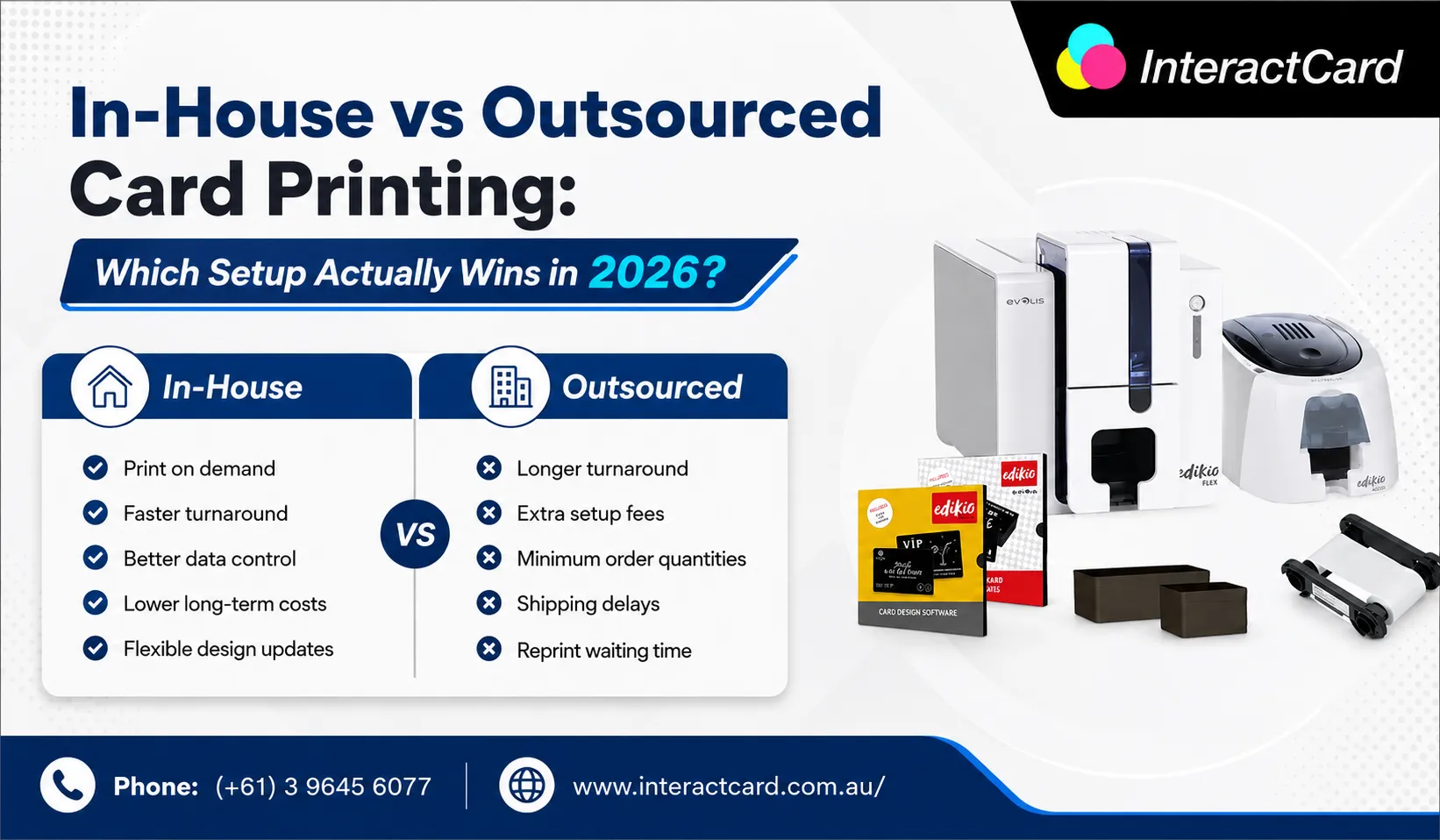
In-House vs Outsourced Card Printing: Quick Comparison
|
Factor |
In-House Card Printing |
Outsourced Card Printing |
|
Turnaround time |
Print cards instantly when needed |
Usually requires order processing and delivery time |
|
Cost control |
Higher upfront cost, lower repeat cost over time |
Lower upfront cost, repeated printing and delivery fees |
|
Data privacy |
Sensitive data stays inside your organisation |
Data is shared with an external provider |
|
Flexibility |
Easy to update designs and print small batches |
Changes may involve extra setup fees |
|
Best for |
Regular card printing and urgent replacement cards |
Occasional or one-time bulk card orders |
|
Branding control |
Full control over design and output |
Depends on supplier process and proofing |
|
Scalability |
Can grow with the right printer model |
May become costly with frequent orders |
Why In-House Card Printing Is Winning in 2026
In 2026, speed and control matter more than ever. Organisations need identity cards that are accurate, secure and available quickly. This is one of the main reasons many businesses are moving toward in-house card printing.
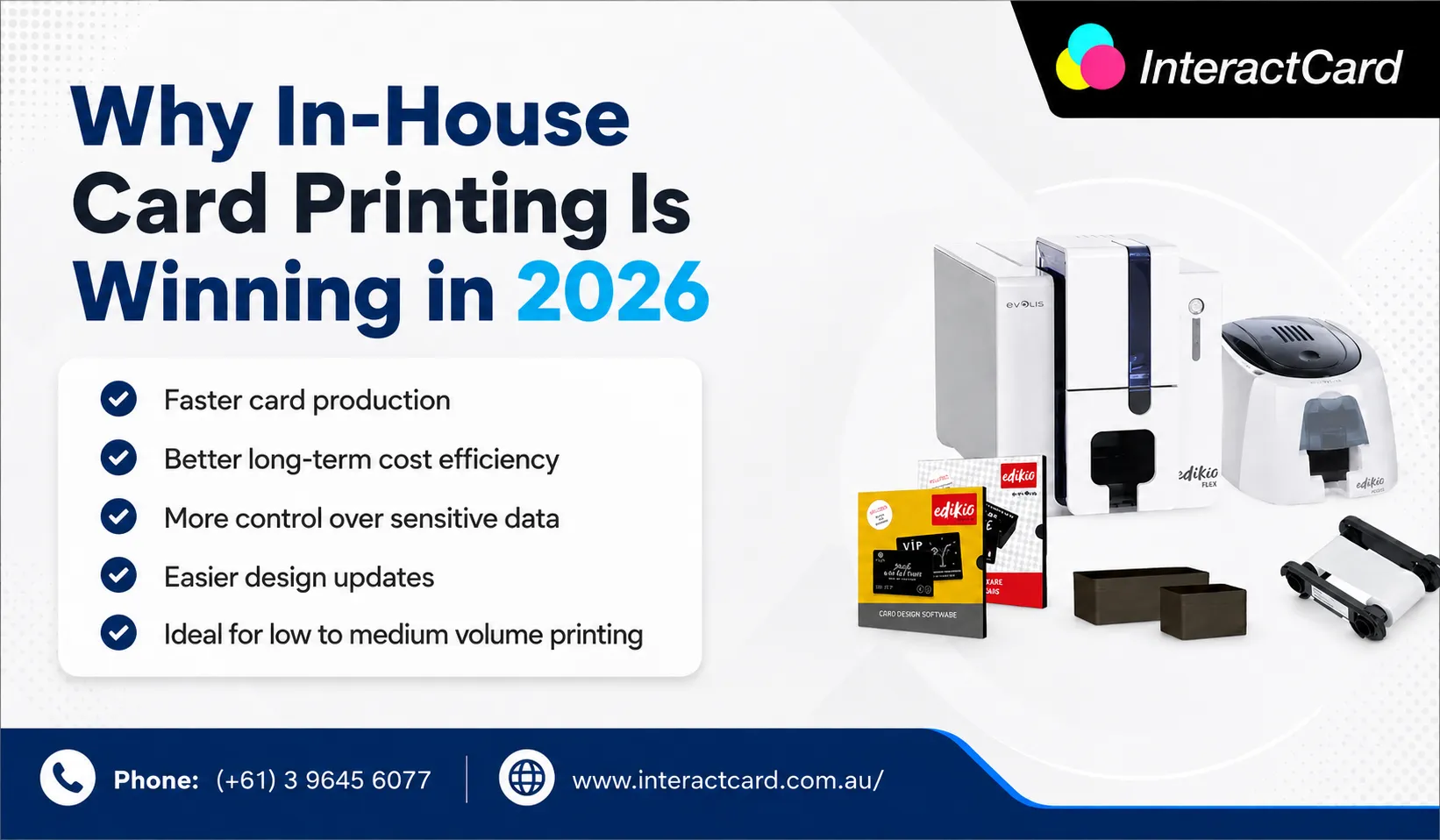
1. Faster Card Production
Outsourcing can involve artwork approval, data submission, production queues, shipping and delivery. If a card contains an error, the replacement process may take even longer.
With an in-house setup, your team can print a new card in minutes. This is especially useful for:
-
New staff onboarding
-
Temporary contractors
-
Lost or damaged card replacements
-
Visitor management
-
Student enrolments
-
Event registrations
For workplaces that rely on physical ID cards for access and verification, faster printing can improve daily operations.
2. Better Long-Term Cost Efficiency
Buying a card printer machine requires an upfront investment, but it can reduce repeated outsourcing expenses over time. Outsourced card printing may include design fees, setup fees, minimum order quantities, delivery charges and reprint costs.
In-house printing allows you to print only what you need, when you need it. This can reduce waste and avoid paying for unnecessary bulk quantities.
For organisations printing cards every month, or even every week, in-house printing can be the more economical option in the long run.
3. More Control Over Sensitive Data
ID cards often contain personal details such as names, photos, job titles, student numbers, membership numbers or access credentials. When outsourcing, this information may need to be shared with an external supplier.
In-house printing keeps the process under your organisation’s control. This can be important for schools, healthcare providers, government contractors, corporate offices and security-conscious businesses.
4. Easier Design Updates
Card designs often change. A business may update its logo. A school may add a new colour system for year levels. A gym may introduce new membership tiers. A retail store may launch a new loyalty program.
With outsourced printing, every change can require new proofs, setup time and additional costs. With in-house printing, your team can update templates and print new cards as needed.
5. Ideal for Low to Medium Volume Printing
Not every organisation needs thousands of cards at once. Many need small batches regularly. This is where in-house printing is especially valuable.
For example, a business might print five staff cards one week, ten visitor badges the next week and twenty membership cards at the end of the month. A compact plastic card printer can handle these needs without the delay of external ordering.
When Outsourced Card Printing Still Makes Sense
Outsourcing is not always the wrong choice. It may still work well if your organisation:
-
Prints cards only once every few years
-
Does not require urgent replacements
-
Has no internal staff to manage printing
-
Needs a very large one-off production run
-
Does not handle sensitive personal data
-
Wants to avoid equipment ownership
If your card needs are rare and predictable, outsourcing may be simple enough. But if your organisation prints cards regularly, the convenience of in-house printing often becomes more attractive.
Choosing the Right Card Printer Machine
The right printer depends on how your organisation will use it. Before buying, consider your volume, card type, security requirements and whether you need single-sided or dual-sided printing.
|
Requirement |
Recommended Setup |
|
Basic staff or visitor cards |
Entry-level direct-to-card printer |
|
Membership or loyalty cards |
Full-colour plastic card printer |
|
Student IDs or employee IDs |
Reliable ID card printer with photo printing |
|
Higher-volume printing |
Printer with larger input capacity |
|
Double-sided cards |
Dual-sided card printer |
|
High-security cards |
Printer with encoding or lamination options |
|
Premium card finish |
Retransfer printer or lamination system |
A small business may only need a compact entry-level printer. A school or corporate office may need a faster printer with greater capacity. A security-focused organisation may need encoding, lamination or retransfer technology.
Why Choose InteractCard for Card Printing Solutions?
InteractCard supports Australian organisations with professional card printing solutions, including Evolis plastic ID card printers, ribbons, blank cards, cleaning kits, accessories and technical support.
One of the major advantages of choosing InteractCard is that customers can access both products and guidance. This is important because many buyers are not sure which printer suits their needs. A school, retail store, corporate office and membership club may all need different features.
InteractCard can help organisations choose solutions for:
-
Staff ID card printing
-
Student ID card printing
-
Visitor badges
-
Membership cards
-
Loyalty cards
-
Access control cards
-
Event badges
-
Plastic card printing supplies
-
Printer ribbons and consumables
-
Printer support and setup guidance
Their product range includes options suitable for basic badge printing through to advanced ID card production. For example, compact printers can suit small offices and clubs, while higher-performance printers can support larger teams, schools and organisations with regular printing needs.
Benefits of Buying from a Specialist Supplier
A card printer is not just another office printer. It uses specific ribbons, blank cards, software and cleaning processes. Buying from a specialist supplier gives your organisation better support and a smoother experience.
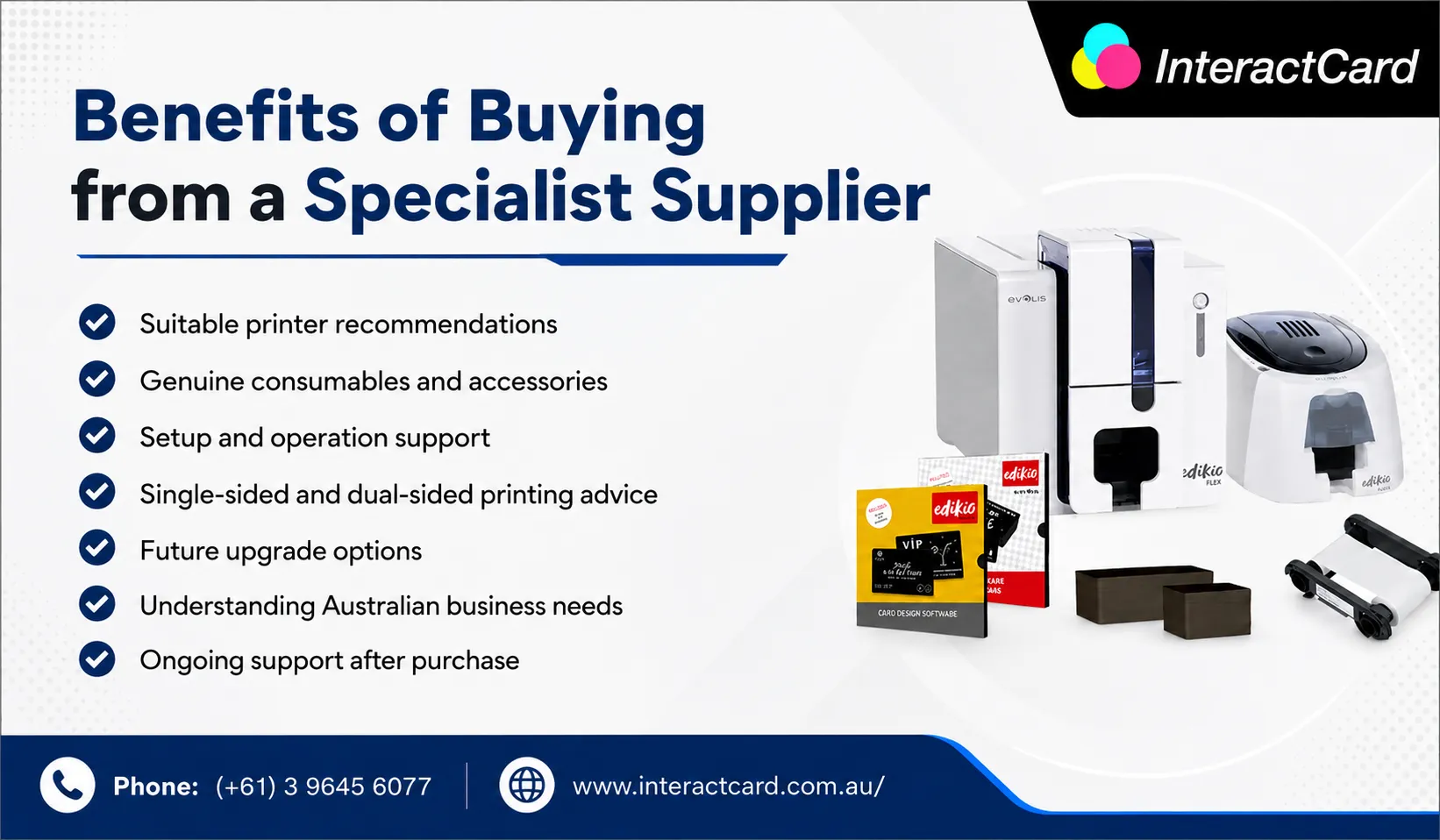
Key benefits include:
-
Access to suitable printer recommendations
-
Genuine consumables and accessories
-
Support for setup and operation
-
Help choosing between single-sided and dual-sided printing
-
Options for future upgrades
-
Better understanding of Australian business needs
-
Ongoing support after purchase
This can help reduce mistakes, protect printer performance and improve card quality.
In-House Printing Use Cases by Industry
Schools and Training Providers
Schools can print student IDs, staff cards, library cards and visitor badges on demand. This is useful during enrolment periods and when students lose cards.
Corporate Offices
Businesses can print employee badges, contractor passes and access cards quickly. This helps with onboarding and workplace security.
Retail Stores
Retailers can produce loyalty cards, staff badges, price tags and promotional cards without relying on external print schedules.
Healthcare and Aged Care
Healthcare facilities can print staff IDs, visitor passes and department-specific badges while keeping sensitive information more controlled.
Clubs and Membership Organisations
Gyms, sports clubs and community organisations can print membership cards instantly, improving member experience.
Final Verdict: Which Setup Actually Wins?
For occasional one-off card printing, outsourcing can still be suitable. But for organisations that print cards regularly, need urgent replacements, care about data privacy or want better control over branding, in-house printing is often the stronger setup in 2026.
A professional plastic card printer gives your organisation the ability to produce high-quality cards on demand. It can reduce delays, improve flexibility and support a more professional identity system.
If your organisation is ready to bring card printing in-house, InteractCard is a trusted place to explore reliable card printers, consumables and support. With solutions for businesses, schools, retailers, clubs and organisations across Australia, InteractCard can help you choose the right card printer machine for your needs today and as your card printing requirements grow.