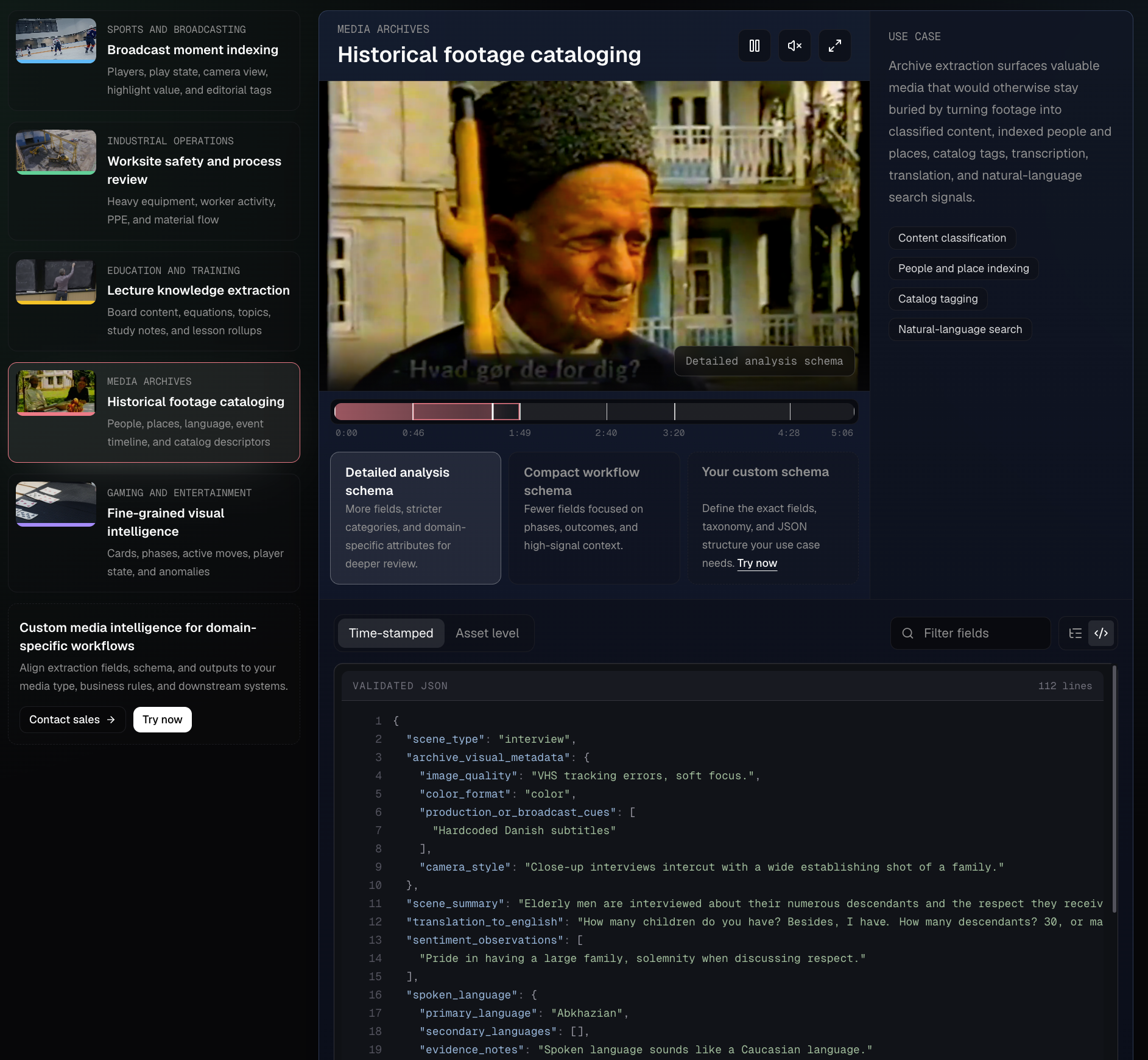
Landing-page showcase for media extraction, timeline markers, and JSON
The gap between a media AI demo and a production system is usually not model quality alone. It is everything around the model: ingestion, schemas, timestamps, search, retries, exports, APIs, SDKs, webhooks, and downstream integration. VectorMethods is built around closing that gap.
At a high level, VectorMethods turns raw video, audio, and image files into structured media intelligence through VideoVector. The platform supports LLM-based video extraction, AI metadata extraction, video scene extraction, video segment analysis, asset-level analysis, multimodal embeddings, and automation-ready outputs.
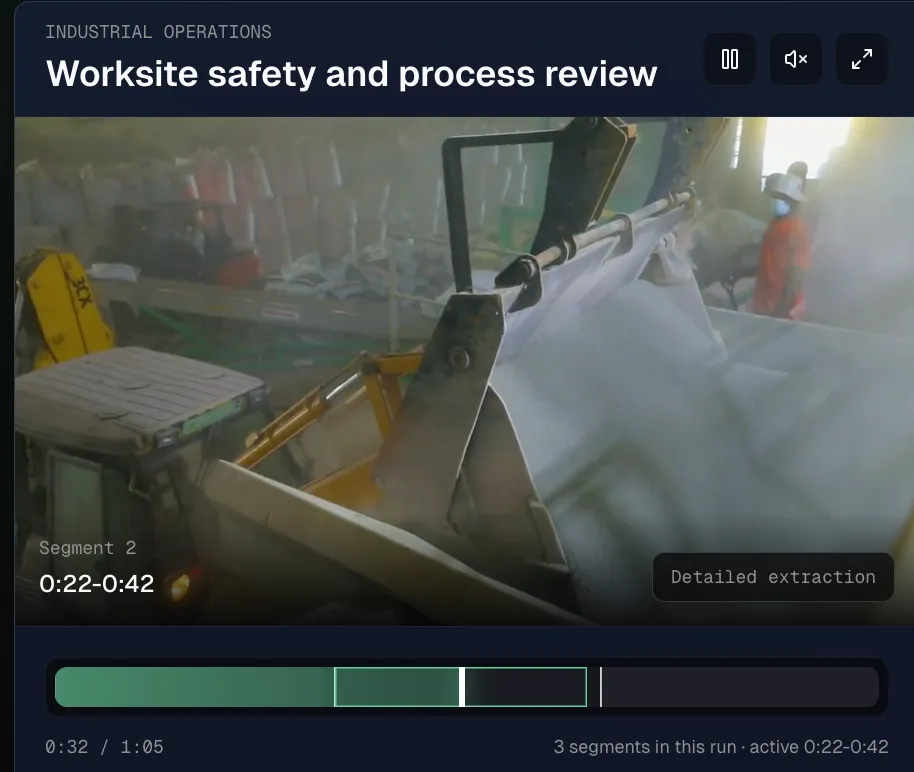
Video detail modal with segment timeline and extracted metadata
A production-ready workflow usually starts with extraction. Raw media is segmented, analyzed, and converted into time-stamped metadata plus a full asset record. Those outputs can describe visual scenes, spoken language, events, entities, objects, topics, safety states, catalog descriptors, or recommendation signals. With video vector embedding search, the same processed media can support semantic retrieval and vector search for video scenes and events.
The next requirement is programmability. The API lets developers create indexes, submit media, define prompts, run jobs, retrieve results, and search processed outputs. This is what lets a product team embed media intelligence into its own backend rather than relying on manual review.
The SDK supports the same goal from application code. A team can build repeatable workflows for prompt execution, schema-backed outputs, search, and handoff. This is useful for internal tools, customer-facing search, analyst workbenches, media copilots, and VideoRAG applications.
Search turns extracted media into a product capability. Natural-language search helps users find scenes by intent. Image and multimodal search support visual discovery. Structured filter and condition search constrain results by metadata fields, timestamps, prompt runs, or indexes. SQL search supports repeatable analysis over extraction outputs. Agentic retrieval supports multi-step investigation and evidence consolidation.
Cloud automation turns the workflow into infrastructure. Media can arrive from cloud storage, be processed with a selected schema, and then flow to downstream systems through exports or webhooks. This is how structured intelligence moves into catalogs, CMS platforms, MAM systems, recommendation services, analytics warehouses, review queues, and reporting tools.
The architecture is simple but powerful: raw assets remain the source of truth, VideoVector creates the structured intelligence layer, and applications consume that layer through search, API, SDK, exports, and automation. That is what moves media AI from an impressive demo into a production platform.